
The "Go Bag"
What is it?
A “Go Bag” is a backpack or duffle bag that contains the essential items you will need during an emergency and when you need to evacuate your home quickly. It includes items such as important documents and medical information, backup equipment, personal necessities for each member of the home, and small non-perishable items.
Why is it Important?
This resource is important because it helps individuals and families leave quickly during an emergency by keeping essential supplies in an easily accessible location. It can be invaluable during situations such as natural disasters, severe weather, house fires, power outages, medical emergencies, or any event that requires rapid evacuation.
Storage
The bag should be kept in a location that is easily accessible, such as near the primary exit of the home. Consider placing a sign near you or on the refrigerator – any central location – to indicate where the bag is stored. This can help caregivers, family members, or first responders quickly locate it if the individual is unable to retrieve it themselves.
Note: While it is an important tool, it should be used alongside other preparedness measures such as developing an emergency communication plan, identifying evacuation routes, and listing where to get emergency medical equipment. The “Go Bag” should be reviewed and updated, if needed, at least every six months.
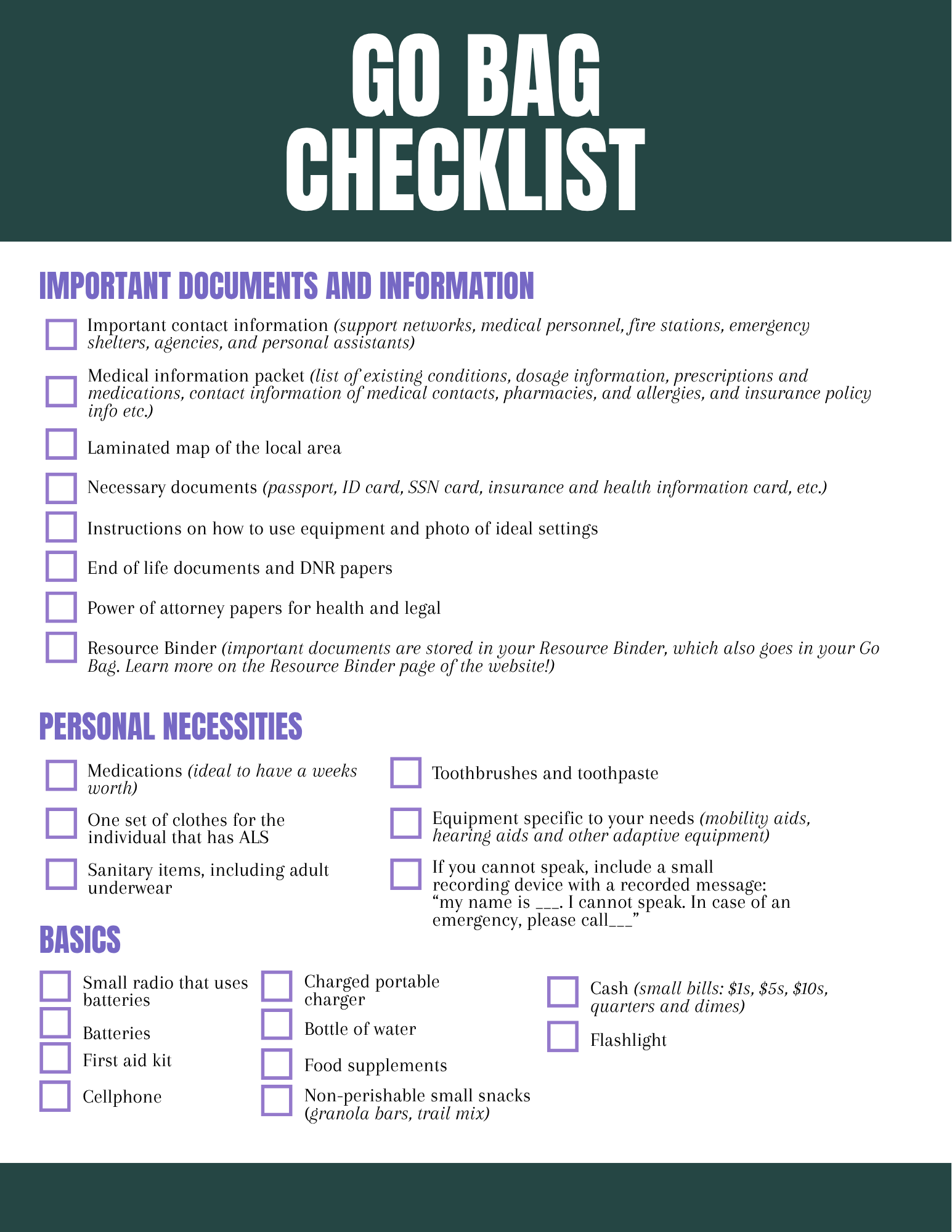
REMINDERS:
As the inclement weather approaches, remember to charge wheelchairs and Hoyer lifts.
Make sure prescription medications and food are stored in bags where you can write their expiration dates.
Aim to replace prescription medication and food every six months to ensure freshness or that they have not exceeded the expiration date.
If you use BiPAPs that have internal batteries, make sure you have an extra one that you keep charged.
Keep a list of additional items on top of your bag or on the refrigerator where caregivers, family members, or first responders can easily find it.
-
Paper-grabber
BiPAP
Cough machine/vest
Straws
Tubes for pencils/utensils
Transfer boards
Gait belts
Voice machines
Dycem
Walking aids (most may not be able to fit in the go bag, but, if applicable, can fit a folded cane)
Tarp (to transfer people who can’t walk)
Suction machine or suction equipment
Bands, putty, balls (for exercise)
References
Emergency Preparedness: ALS United Mid. Atlantic. (n.d.). https://alsmidatlantic.org/care-services/emergency-preparedness/
Emergency Preparedness for People with ALS: ALS Network. ALS Network. (n.d.). https://alsnetwork.org/understanding-als/living-with-als/emergency-preparedness-for-people-with-als/
Emergency Preparedness Toolkit. International Alliance of ALSMND Associations. (n.d.). https://www.als-mnd.org/support-for-pals-cals/advocacy/emergency-preparedness-toolkit/